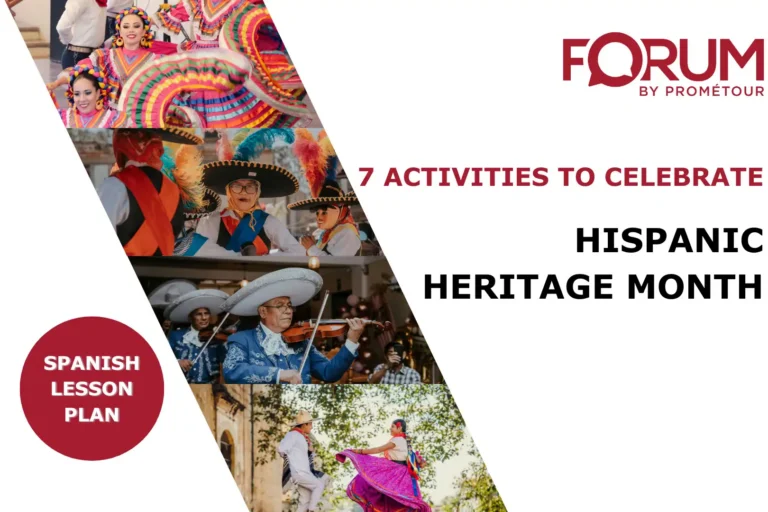
September 15 to October 15 marks Hispanic Heritage Month, a time for celebrating the culture, history, and achievements of Hispanic Americans. For Spanish teachers, it’s also a time to educate students about the vast diversity of the Spanish-speaking world.
The seven activities below allow your students to collaborate with one another, listen to the perspectives of others, learn about Hispanic traditions, and reflect on social justice issues affecting communities. You can try one in a single class period or select a few activities to cover the entire month to understand and celebrate Hispanic heritage month with your students.
Activity 1: Connect virtually with a classroom in Spain
Give your students the chance to use Spanish with peers their own age. Through our free virtual exchange program, your class can meet a partner classroom in Spain, compare daily routines and school life, and practice conversation in a setting that feels real. Submit an interest form and we can match you with a partner classroom.
FREE VIRTUAL EXCHANGE FOR YOUR SPANISH CLASSES
Give your students the opportunity to interact with students in Spain
After exploring Hispanic cultures in class, let your students continue the conversation with students in Spain. Connecting Classrooms is a free video exchange where classes create and share short videos about their school life, hometown, and culture.
FREE FOR SCHOOLS • GUIDED ACTIVITIES • TEACHER SUPPORT
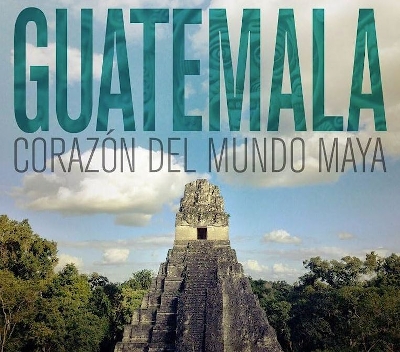
Activity 2: Watch a documentary, film, or series celebrating Hispanic and indigenous cultures
A classroom movie day can introduce students to people, places, and experiences they may not encounter in a textbook. These student-friendly selections offer several good starting points:
Lorena, Light-Footed Woman (2019, Netflix, TV-G) – Meet Lorena Ramírez, an ultramarathon runner from Mexico’s Indigenous Rarámuri community who competes internationally while remaining connected to her culture and traditions.
Pachamama (2019, Netflix, PG) – In this animated adventure set in the Andes, a young Indigenous boy embarks on a journey to recover a sacred statue taken from his village.
Viva la Causa (2008, Grades 7–12) – This 39-minute documentary examines the historic grape strike and boycott led by César Chávez and Dolores Huerta and the movement for farmworkers’ rights in the United States.
Where the Tracks End (El último vagón) (2023, Netflix, TV-14) – In rural Mexico, a teacher named Georgina is determined to make a difference in the lives of the young, bright students attending school in a converted railcar.
Street Food: Latin America (2020, Netflix) – This show won Best Informational Program at the Imagen Awards and provides a fun and engaging way to enhance your students’ language learning experience while exploring the people, traditions, and personal stories behind popular foods from Argentina, Brazil, Bolivia, Colombia, Mexico, and Peru.
A Million Miles Away (2023, Prime Video, PG) – Based on the true story of José Hernández, a migrant farmworker who became a NASA astronaut, this inspiring film explores perseverance, family, education and the importance of remaining connected to one’s Mexican heritage while pursuing an extraordinary dream.
Activity 3: Examine the impact of the Tren Maya
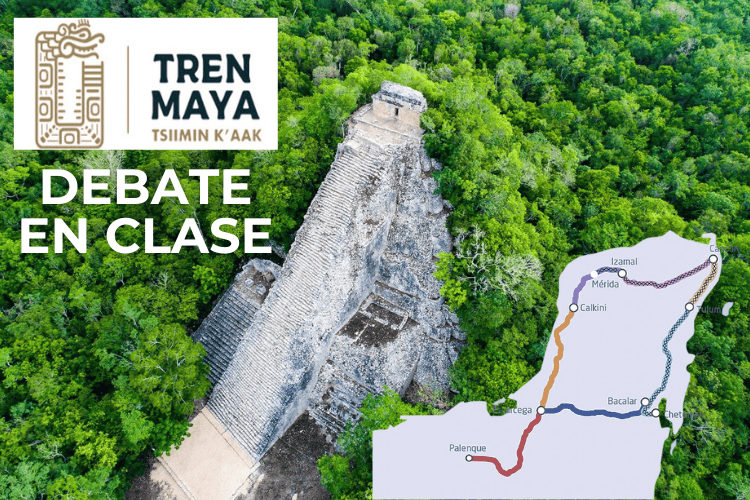
The Tren Maya is a unique opportunity for students to examine the impact of infrastructure projects and tourism on local communities, ecosystems and cultural heritage.
The project, which runs along Mexico’s yucatan peninsula, has been pitched as a boon to transportation, tourism and economic opportunity, but Indigenous communities and environmental activists have voiced concerns over land rights, forced displacement, destruction of habitats and the use of maya culture to attract tourists.
UNESCO has also requested a fuller assessment of the project’s effects on World Heritage properties along the route and emphasized the importance of participation from local and Indigenous communities.
In this lesson plan, students compare primary and secondary sources before taking part in a structured discussion. Ask them to consider who benefits from the project, who carries the risks, and whose voices should help shape these decisions.
The goal is to build persuasive Spanish skills while exploring issues related to development, Indigenous rights and cultural heritage.
FROM THE CLASSROOM TO MEXICO CITY
What could these conversations look like in Mexico City?
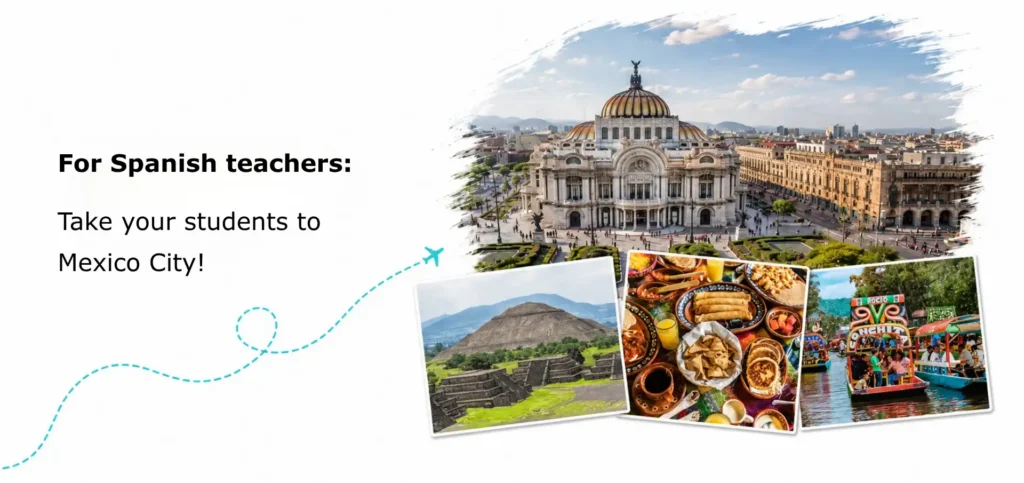
These activities introduce students to cultures and perspectives from across the Spanish-speaking world. A seven-day tour of Mexico City gives them the chance to explore one of those stories more deeply through language, history, art, food, and daily life. Students can visit Templo Mayor and the National Museum of Anthropology, take a cooking class, and experience the canals of Xochimilco.
Keep reading for more Hispanic Heritage Month activities below.
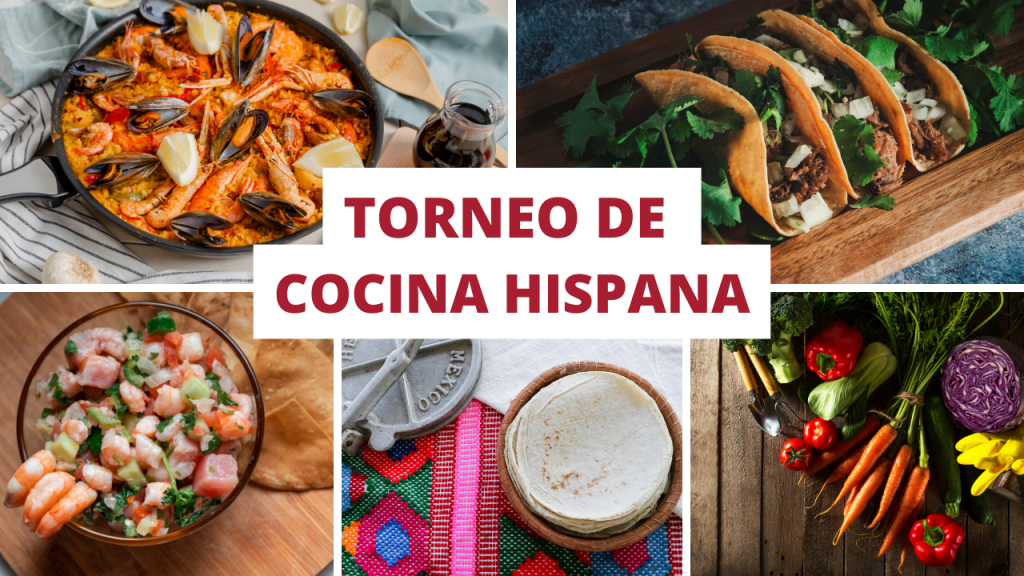
Activity 4: Host a Torneo de la Comida Hispana
Bring the excitement of a World Cup knockout stage style tournament into your classroom to celebrate the incredible variety of food across the Spanish-speaking world.
Assign each student or small group a Spanish-speaking country and have them research a dish connected with it. Their research can include the dish’s ingredients, region of origin, history, and cultural importance.
During each round, groups give a short presentation in Spanish explaining why their dish should advance. The class then votes on the winner. Remind students that no single dish represents an entire country, so regional differences should be part of the conversation.
Download the bracket, worksheet, and instructions from our Torneo de la Comida Hispana activity.
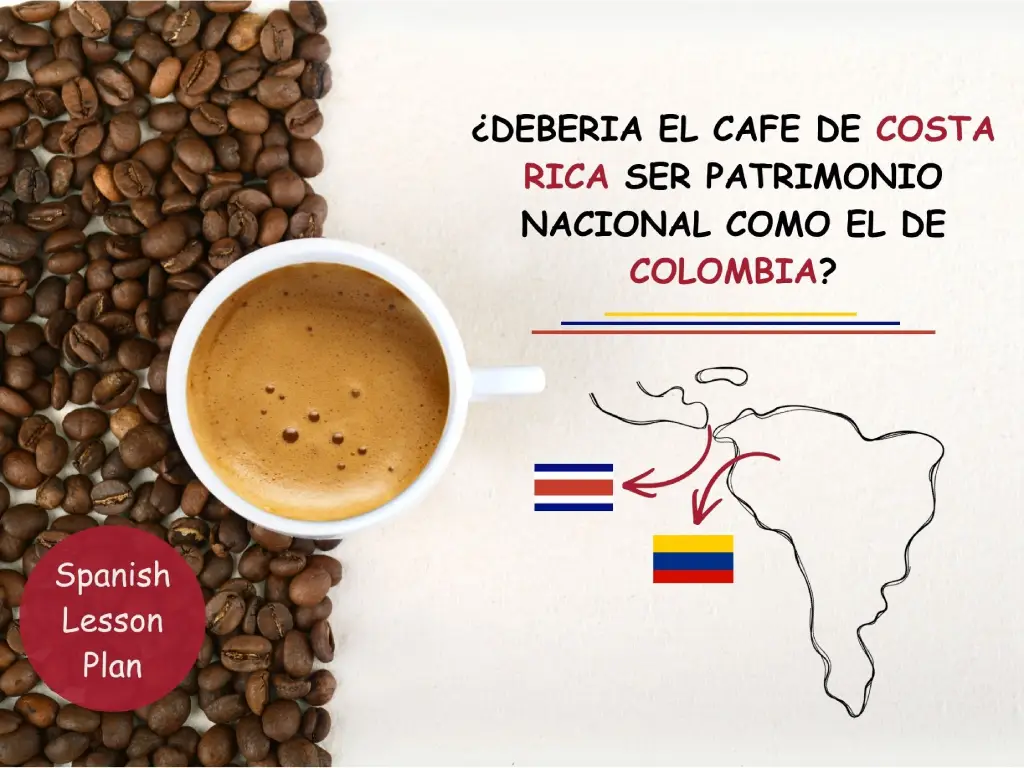
Activity 5: Explore coffee culture in Costa Rica and Colombia
Coffee is more than an export. It has molded landscapes, created communities and been woven into the fabric of daily life across Latin America.
This partner activity has one student research the role of coffee in Costa Rica, the other in Colombia, then share their discoveries and discuss the role that culture plays in defining these global industries.
Colombia’s coffee cultural landscape was recognized as a UNESCO World Heritage Site in 2011. Use it to spark conversations about what it takes for an agricultural landscape to become cultural heritage, and whose perspectives and practices deserve to be preserved.
Activity 6: Listen to a playlist celebrating Hispanic heritage

Begin each class with a song. Ask students to write down the words and phrases that they recognize, then share their observations with a partner before discussing country of origin, artist, genre or cultural background.
Our Travel Program Adviser Alex, who is from Valencia, curated the Spotify playlist Celebrando la herencia musical hispana.
It features music from artists such as J Balvin, Chavela Vargas, and Lola Flores. It also introduces students to the innovative work of Peruvian artist Renata Flores, who integrates the Indigenous Quechua language into pop and rap.
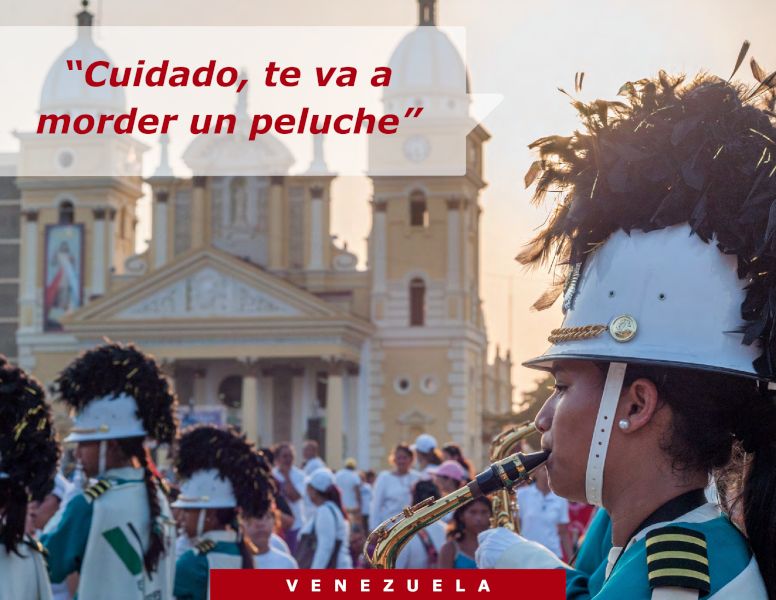
Activity 7: Practice Spanish idioms
Idioms are often the most challenging-and most amusing-aspects of learning a language.
Our Spanish idioms activity includes a worksheet and answer key covering 12 expressions from across the Spanish-speaking world.
Ask students to begin with a literal translation and then use context to guess the expression’s real meaning. They can also compare each idiom with a similar expression in English or another language they know.
Take Spanish Learning Beyond the Classroom
Ready to help your students take their learning beyond the classroom? Forum can help you plan an educational trip to a Spanish-speaking destination, including Spain, Mexico, Costa Rica, Puerto Rico and more.
Contact us to start building a program around your language and learning goals.

Erendira Torres
Hola,
Me gusta el sistema que tienen para desarrollar las diferentes actividades incluyendo los diferentes paises y la cultura Hispana. Es una ingeniosa ,manera de enseñar la cultura hispana a los estudiantes.
Erendira Torres
Excelente informacion
Eloisa Flores
THnak you soooo much for this!!!